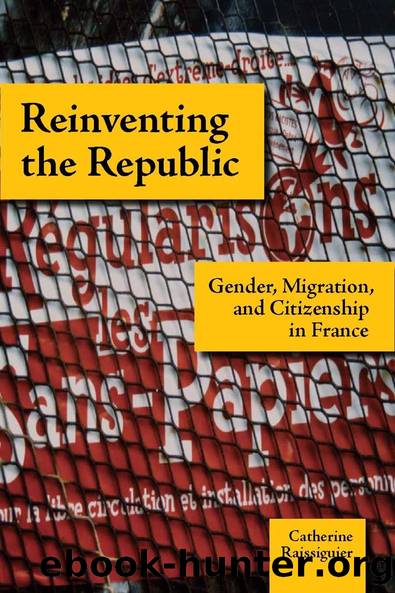
Reinventing the Republic by Catherine Raissiguier
Author:Catherine Raissiguier [Raissiguier, Catherine]
Language: eng
Format: epub
Tags: Social Science, Anthropology, Cultural & Social, General, Political Science, Civics & Citizenship, Emigration & Immigration, Sociology, Women's Studies
ISBN: 9780804757614
Google: DWpsHOMWaf8C
Publisher: Stanford University Press
Published: 2010-06-03T03:22:13+00:00
WITHOUT PAPERS, BUT NOT WITHOUT WORK
Although I did not set out to find out what sans-papières did for a living, many of my interviews provide interesting information about the employment trajectories, the work realities, and the economic struggles of the women involved in the sans-papiers movement. All of the women I interviewed found positions in the black market [travail au noir] when they were undocumented and most saw the ability to secure legal work as one of the key benefits of their legal change of status. Many addressed the difficulty of making a living while sustaining their involvement in the struggle. Most of the interviews show that, regardless of their country of origin and regardless of their marital and familial status, sans-papières take wage labor for granted and are engaged in some form of income-generating activity. Some of the leaders of the movement are now legally employed within militant structures loosely connected to the sans-papiers struggle (labor unions, NGOs, and so on). However, the women I interviewed often downplayed this outcome of their involvement in the struggle, in part to avoid criticism of petty entrepreneurship and personal gains attained through their role in the movement.
Aminata, one of the few women still involved in the national leadership of the sans-papiers movement, is from Senegal and once worked as a cleaning lady. She explained to me that she already had a job before becoming active in the movement but she eventually lost it because of the disruption caused by her militant activities.29
Aminata: Before I became involved with the [sans-papiers] struggle, I had everything. I was working when I became involved in the struggle. But then I lost my job. . . . I was often late because of the meetings, so at the end I had problems.
CR: What were you doing?
Aminata: I worked as a domestic help. They [my employers] pushed me aside without laying me off completely. They would give me two hours [of work] per day, one hour per day. . . . I would go and help the elderly. I would shop for themâtwo hours here, one hour and a half there!
Download
This site does not store any files on its server. We only index and link to content provided by other sites. Please contact the content providers to delete copyright contents if any and email us, we'll remove relevant links or contents immediately.
The Secret History by Donna Tartt(19088)
The Social Justice Warrior Handbook by Lisa De Pasquale(12190)
Thirteen Reasons Why by Jay Asher(8910)
This Is How You Lose Her by Junot Diaz(6887)
Weapons of Math Destruction by Cathy O'Neil(6280)
Zero to One by Peter Thiel(5802)
Beartown by Fredrik Backman(5754)
The Myth of the Strong Leader by Archie Brown(5507)
The Fire Next Time by James Baldwin(5446)
How Democracies Die by Steven Levitsky & Daniel Ziblatt(5219)
Promise Me, Dad by Joe Biden(5153)
Stone's Rules by Roger Stone(5088)
A Higher Loyalty: Truth, Lies, and Leadership by James Comey(4964)
100 Deadly Skills by Clint Emerson(4925)
Rise and Kill First by Ronen Bergman(4789)
Secrecy World by Jake Bernstein(4753)
The David Icke Guide to the Global Conspiracy (and how to end it) by David Icke(4720)
The Farm by Tom Rob Smith(4512)
The Doomsday Machine by Daniel Ellsberg(4490)
